
AI Scope of Work in Construction: From Drawings to Structured Output

Summarize this post:
Instantly extract the key takeaways from this article using AI.
In most construction projects, scope gaps don’t start on-site; they start in the documents.
Drawings, specifications, and notes hold the full picture, but rarely in a way teams can directly use. That’s where the challenge begins.
The scope of the construction process defines how a project moves from design to execution. Drawings and specifications are combined to provide a precise construction project scope of work that delineates deliverables and allocates responsibilities.
In reality, teams must collaborate across several designs, disciplines, and technical standards in order to create a trustworthy construction scope of work document. Each document contains part of the overall scope, but not in a structured or ready-to-use format.
As projects become more complex, it gets harder to arrange the information into a precise and uniform scope of work for a construction project as projects get more complicated.
This is where AI in construction is changing how teams create structured, accurate, and usable scope directly from source documents.
The precise duties, actions, and deliverables needed to finish a project are outlined in a scope of work document. It converts design intent into a format that can be used by teams for execution, coordination, and estimation. In practice, this document becomes the foundation for bidding, trade coordination, and contract clarity.
A complete construction project scope of work includes:
To build this, teams rely on drawings and specifications as the primary source of truth.
The challenge is not the availability of information. It is how that information is extracted, connected, and structured into a usable format.
Creating a clear and consistent construction scope of work document requires teams to work through large volumes of project data.
Several factors make this process complex.
Most teams still rely on a manual workflow to create a scope of work for a construction project.
The process typically includes:
This results in a final construction scope of work document used for bidding, buyout, and contracts.
While this approach works, it requires significant time and repeated validation. Teams often revisit the same documents to ensure nothing is missed.
The process depends heavily on manual effort and consistency.
The way construction teams approach scope generation is changing as a result of AI.
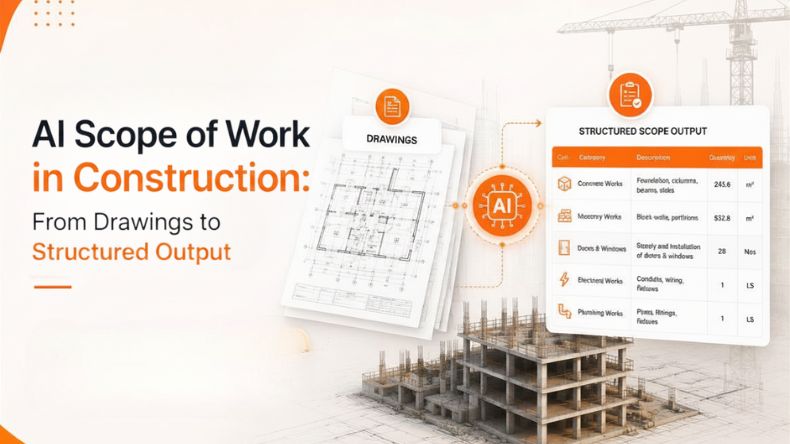
Teams can now use tools that process drawings and specifications as a single dataset rather than going over each item individually. AI-powered systems can now transform raw project data into structured outputs.
Working with organized data that is already related and structured takes precedence over manually assembling the scope.
Instead of creating the scope from the ground up, this enables teams to devote more effort to reviewing and improving it.
From a user perspective, the workflow remains simple and direct.
Step 1: Upload project documents
Teams upload drawings and specifications into the system.
Step 2: Extract and connect information
The system reads all text, notes, and references. It connects information across drawings and specifications.
Step 3: Identify scope elements
It organizes scope-related information based on trades, disciplines, and requirements.
Step 4: Interact through queries
Users can request specific outputs such as:
Step 5: Generate structured outputs
The system produces:
All outputs are based directly on project documents.
AI does not replace scope creation. It improves how the scope is structured and organized.
It helps standardize:
This creates consistency across projects and teams.
When teams work with a structured scope of work construction, the improvements are immediate.
Workflows in construction are becoming more organized and data-driven.
By 2026, leading construction teams will rely on AI to generate and structure scope instead of building it manually.
Scope will no longer be built line by line. It will be generated, structured, and refined through interaction with project data.
This shift will improve how teams handle:
The focus will move from gathering information to working with it effectively.
The challenge in the scope of work construction is not missing information. It is structuring existing information into a clear and usable format.
Drawings and specifications already contain everything teams need. The difficulty lies in connecting and organizing that information efficiently.
AI introduces a new way to approach this process.
It helps teams create precise, uniform construction scope-of-work documents without relying solely on human labor by converting project documents into structured outputs.
Better clarity, greater alignment, and more assured project execution from the outset result from this.
Explore more insights on similar topics
 SCOPE MANAGEMENT
Building massive things gets very messy sometimes. Teams start with blank paper and hopes. Workers...
 SCOPE MANAGEMENT
Stop Chasing Scope Across Drawings with an AI scope of work generator. Construction teams waste...
 SCOPE MANAGEMENT
TL;DR Why Structured Scope Intelligence Is Becoming Essential in Construction Structured scope intelligence is transforming...