How AI Reduces Construction Rework across Drawings, Coordination, and Field Workflows

Summarize this post:

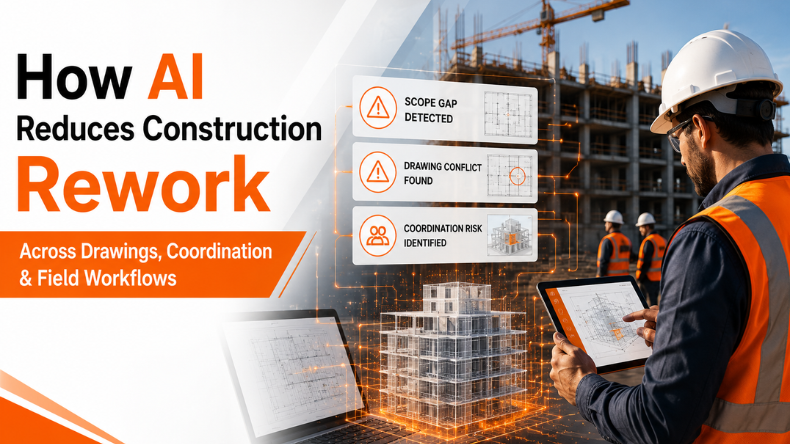
Instantly extract the key takeaways from this article using AI.
Every construction team knows the pain of rework.
A crew finishes an installation. Days later, someone spots a missed detail. The work comes out. The team starts over.
Time slips away. Budgets take a hit.
Frustration spreads across the project.
The hard part is that rework rarely starts in the field. Most of it begins much earlier.
A note gets missed in a drawing. A scope item falls through the cracks.
An email sits unread. A meeting decision never reaches the right trade.
Small issues stack up. Then they show up on site when the cost of fixing them is much higher.
That is why many firms are now looking at AI in a different way. Not as another software tool. Not as another dashboard.
Instead, they see it as an extra set of eyes.
One that can review project information around the clock.
One that can spot gaps before crews arrive.
One that can help teams stay aligned from design through closeout.
As the industry is moving toward a new phase of project delivery, AI is starting to play a bigger role in reducing rework across drawings, coordination, and field operations.
Most field mistakes have roots in earlier project stages.
The warning signs are often there.
They just stay hidden.
A detail on one sheet may not match another. A specification may call for something different. A coordination note may never reach the right team.
Finding those issues takes time.
On large projects, teams review hundreds of drawings and thousands of pages of documents. Even experienced professionals can miss something.
This is where iFieldSmart AI starts helping.
AI can review drawings and specifications together. Instead of looking at silo information, it gives you a snapshot of the overall project.
That wider view matters.
It also helps uncover conflicts, missing information, and possible risks much earlier.
The sooner teams find these issues, easier the fix.
A problem found during planning may take minutes to solve.
The same problem found during installation may take days.
That simple shift is driving greater interest in AI construction rework reduction.
Construction projects generate a huge amount of information.
Every day brings new drawings.
Also, keeping track of everything is not simple.
Sometimes a revised drawing never reaches the field.
Sometimes a project requirement sits buried inside a specification.
Sometimes teams spend hours looking for answers.
AI helps cut through that noise.
Also, the system reviews information across drawings, specifications, and other records.
That saves time and reduces confusion.
When teams can quickly find the right information, decisions become better.
And better decisions mean less rework.
Scope gaps are one of the most common causes of rework.
They are also one of the hardest issues to spot.
A drawing may show an item. The specification may not mention it.
A responsibility may appear obvious to one team but not to another.
Months later, everyone discovers that nobody planned for the work.
Then the change orders begin. Then schedules move.
Then costs rise. AI helps identify these gaps earlier.
By reviewing project documents together, iFieldSmart AI can highlight missing scope items, and areas where project requirements do not work.
This gives teams a chance to address issues before construction begins.
The value is easy to see.
A conversation during planning costs very little.
A field correction costs much more.
Strong construction rework prevention starts with finding these hidden gaps before they become active problems.
Construction projects involve many moving parts.
Owners want updates. Architects issue revisions.
Contractors manage schedules. Trade partners handle installation.
Everyone depends on accurate information.
Keeping those groups aligned is often harder than the work itself.
A single missed update can affect multiple teams.
That is why coordination remains one of the biggest challenges in construction.
AI helps by connecting information that normally sits in separate places.
When these sources work together, teams gain better visibility into project decisions and requirements.
The result is stronger AI for construction coordination across the entire project team.
Drawing reviews have always been a critical part of project planning.
They are also time consuming.
A large project may contain hundreds of sheets.
Each sheet contains details, notes, dimensions, references, and requirements.
Reviewing everything manually takes effort.
Even then, some issues slip through.
AI construction drawings review adds another layer of support.
Instead of focusing on a single sheet, AI reviews drawings alongside specifications and related project documents.
That broader review helps identify inconsistencies and missing information that may otherwise stay hidden.
Teams spend significant time searching through drawings and specifications to answer project questions. AI can help retrieve relevant information from project documents faster, allowing teams to verify requirements, clarify details, and resolve questions before they become field issues. Instead of manually searching across hundreds of sheets and specification sections, project teams can quickly locate the information they need to keep work moving.
This becomes especially valuable during constructability reviews.
Teams can evaluate their work.
They can identify potential conflicts before materials arrive.
They can address concerns before crews begin work.
Finding problems earlier is still one of the best ways to reduce rework.
AI simply helps teams do that more consistently.
Construction does not run on drawings alone.
Communication drives every project.
The challenge is keeping all that information organized.
Important details can disappear inside long email chains.
Meeting notes can get overlooked.
Change requests can move slowly.
AI helps bring structure to these activities.
Meeting intelligence tools can capture discussions and highlight key actions.
Email tools can help teams track project communication.
Change management tools can review project information and support decision making.
Together, these capabilities help teams stay informed without spending hours reviewing records.
The goal is not replacing people.
It is helping people spend less time searching and more time solving problems.
That is where iFieldSmart AI powered construction workflows start showing real value.
Most construction coordination software stores information.
That is useful.
But finding the right information still takes effort.
AI adds another layer.
It helps teams understand what the information means.
Instead of simply storing documents, AI can review project data and identify possible risks, gaps, and coordination concerns.
This gives project teams faster access to useful insights. Project managers can review issues sooner.
Coordinators can spot conflicts earlier. Leadership teams can gain a clearer view of project health.
The benefit is not speed alone. It is clarity.
And clarity often leads to better decisions.
As construction coordination software becomes more intelligent, teams gain stronger tools for reducing costly mistakes.
Field teams need accurate information every day.
Without it, mistakes happen.
Any of these can trigger rework.
AI helps support construction field coordination by connecting field activities with project data.
Teams can verify information faster. They can review requirements with greater confidence.
They can identify concerns before work moves too far ahead. Reality capture data adds another layer of visibility.
Project teams can compare field conditions against project requirements and identify issues earlier.
That visibility helps everyone stay aligned. When field teams have better information, they can be accurate in their installation.
That reduces delays. It reduces waste. And it reduces rework.
Most rework does not begin with a major mistake.
It starts with small issues that nobody notices.
AI gives project teams another way to find them.
By reviewing project information, supporting coordination, analyzing scope, and helping teams find answers faster, iFieldSmart AI helps reduce the conditions that lead to rework.
The construction industry is entering a period where information matters more than ever.
Projects are larger. Schedules are tighter. Teams work remotely.
The ability to find right information at the right time is becoming a major advantage.
The firms that reduce rework most effectively will not be the ones that react faster.
They will be the ones who identify problems before crews ever pick up a tool.
That shift is already beginning.
And AI is becoming an important part of it.
A commercial office project is moving through preconstruction.
The electrical drawings show power for new equipment.
The specifications mention the equipment.
During a scope review, iFieldSmart AI reviews the drawings and specifications together and flags a possible gap.
Teams see the equipment along with power.
But the mounting support is missing from the scope.
The project team reviews the finding.
After a quick discussion, teams get their work.
Without that review, the issue may have surfaced months later during installation.
That could have delayed work, triggered extra costs, and caused disputes between trades.
Instead, the team fixes the issue early and moves forward with confidence.
A healthcare project is preparing for mechanical installation.
One drawing shows a duct route through a ceiling space.
A newer revision changes the route.
The field team is unaware of the update.
AI reviews the latest project documents and identifies a mismatch between the drawing versions.
The project team receives an alert.
The updated routing information reaches the field before installation begins.
The crew installs the system correctly the first time.
No demolition.
No schedule impact.
No wasted labor.
Before it becomes expensive rework, you need to resolve issues.
1. How can you use AI to answer questions from drawings and specifications?
A question comes up. The answer is somewhere in the drawings. Then the search begins.
AI cuts down that hunt. It checks the project files and extracts the relevant information. Instead of running between dozens of documents, teams can get answers much faster and keep work moving.
2. What does an AI constructability review do?
Sometimes a design can look good on paper, but becomes difficult. A duct might clash with another system. A detail might not fully work once crews begin installation.
AI helps spot these kinds of issues early. Not every issue turns into rework, of course. But finding them before construction starts is always better than finding them after.
3. How does AI find scope gaps?
Scope gaps usually hide in plain sight.
A drawing shows something. The specification says something else. Everyone assumes another trade has it covered.
Then, weeks later, someone realizes nobody owns the work.
AI reviews project documents together and points out areas that may need a closer look. It helps teams catch missing scope before it turns into a field problem.
4. Can AI help reduce change orders?
It can help reduce the reasons change orders happen.
Maybe a requirement was unclear. Maybe two documents did not match. Maybe a scope item slipped through review.
AI helps bring those issues to the surface sooner.
5. Which construction teams can benefit from AI?
Pretty much any team that works with project information.
Project managers use it to find answers faster. Estimators use it during reviews. Trade partners use it when checking scope. Design teams use it when reviewing project documents.
The common thread is simple. Less time searching. More time solving problems.
6. Can AI help reduce RFIs?
Many RFIs start because something is unclear.
A note is missing. A detail does not match. A requirement needs clarification.
AI helps uncover some of those questions during project reviews. That does not mean RFIs disappear completely. Construction is rarely that simple.
Explore more insights on similar topics
 DRAWING & DESIGN REVIEW
Construction requires many drawings, specs, RFIs, and changes. When asked something as simple as the...
 DRAWING & DESIGN REVIEW
Most construction issues do not originate in the field. They emerge much earlier, embedded in...
 DRAWING & DESIGN REVIEW
The average construction professional spends around 15 hours a week searching through drawings. Not reviewing...