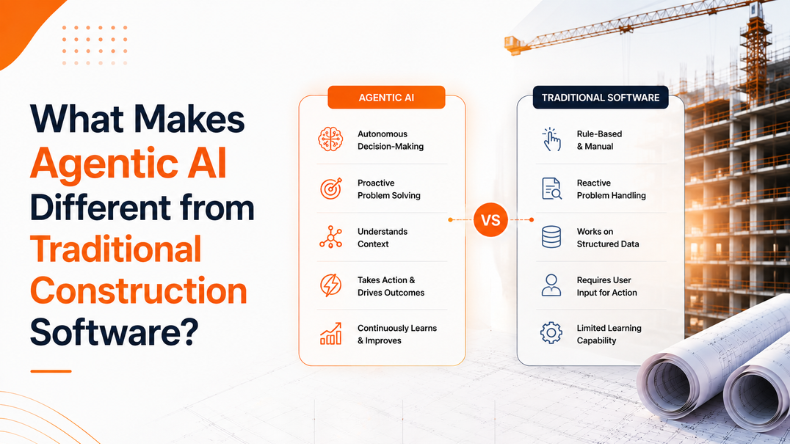
What Makes Agentic AI Different from Traditional Construction Software?

Summarize this post:
Instantly extract the key takeaways from this article using AI.
The construction industry has spent decades building better filing cabinets.
Scheduling software that organizes timelines. Document platforms that store drawings. RFI trackers that log requests. Submittal portals that record approvals. All of it is useful. All of it passive. And none of it is capable of doing the one thing construction projects actually need: catching problems before they become costs.
That is the defining limitation of every construction software platform built before agentic AI. And it is why, despite billions in technology investment, the industry’s core numbers have barely moved.
92% of projects continue to report budget overruns of 6% or more, according to a study of more than 2,000 AECO specialists worldwide. McKinsey estimates that global construction inefficiencies cost USD 1.6 trillion a year. According to PMI research, one in three project failures is primarily caused by inadequate communication.
These are not new problems. They are old problems that existing software was never built to solve.
Traditional construction software operates on a simple contract: a person opens it, a person uses it, and can act on what they find. The software does nothing without that initiation.
That model worked when projects were smaller, and coordination demands were contained. It does not hold up on a large commercial project where a project manager simultaneously oversees:
The software holds all of that. However, a human is needed to open it, review the appropriate object, and recognize the appropriate signal at the precise moment.
Most of the time, someone does. Sometimes they do not. And in an industry where 45% of firms report cost overruns of 6-10% and another 42% report overruns of 11-20%, that gap between what the software holds and what the team actually catches is the gap where margin disappears.
The problem is not the tool. It is the model. Passive software and active projects are increasingly becoming a structural mismatch.
Agentic AI represents a different approach to construction technology. Rather than waiting for users to search for information, these systems are being developed to continuously monitor project data, identify meaningful signals, and surface information that requires attention.
Traditional software is designed to store and locate information. Agentic AI systems are being developed to understand context, identify relationships, and support action across project workflows. The goal of agentic AI is to help maintain awareness of project context, identify meaningful changes, and assist teams in understanding potential downstream impacts.
Here is what that looks like on a live project, using the most common coordination failure point in construction: the overdue RFI.
With traditional software, the sequence looks like this:
To understand the potential impact of agentic AI, consider one of the most common coordination challenges in construction: the overdue RFI:
Same project data. The difference is how quickly risks are identified and addressed. The difference is not smarter software. It is software that acts.
Traditional construction software holds information. Agentic AI reasons over it in real time.
This single difference removes one of the most common failures in construction project management: issues that exist in the system, but are not noticed in time.
Most construction platforms automate isolated steps. Agentic AI executes entire workflows from start to finish without manual handoffs between steps.
No person needs to intervene between steps unless the situation requires a judgment call that only a human can make.
Traditional construction platforms live in separate functional lanes. Scheduling in one system, drawings in another, financials in a third, RFIs in a fourth. Each does its job. None of them generates insight across the boundaries between them.
Agentic AI has the potential to connect information that traditionally lives in separate systems. A drawing revision may affect schedule milestones, cost exposure, contract obligations, and field execution simultaneously. Rather than treating these as isolated events, intelligent systems can help teams understand how changes propagate across a project.
A drawing revision is not just a drawing revision. In a connected agentic system, it is a trigger that sets off a reasoned chain of responses across schedule, cost, and contract. Traditional software treats it as a file. Agentic AI treats it as an event with consequences.
This is the operating model shift that carries the most practical significance for project teams and the firms running them.
The result is not just faster execution. It is a different way to structure a project team, and a fundamentally different relationship between the people running a project and the technology supporting them. Construction firms building toward this model, including early platforms like iFieldSmart AI skills, are not only optimizing existing workflows. They are helping solve the problem of fragmented workflows.
The AI in the construction market continues to develop rapidly, growing from USD 4.86 billion in 2025 to a projected USD 35.53 billion by 2034, at a CAGR of 24.80%. That growth does not reflect experimentation. It reflects an industry facing a coordination problem that passive tools have failed to solve, now reaching for the first tool category that actually matches the pace of a live project.
At average margins of 6%, and sometimes as low as 2-3%, construction firms cannot absorb coordination failures the way higher-margin industries can. Every missed signal compounds. Every delay generates downstream costs. The industry has effectively normalized a 10% tolerance for missing targets, representing billions in lost value across project cycles. That normalization exists not because construction teams accept failure, but because the tools available have never been capable of preventing it at scale.
The challenge is not access to technology. It is implementing technology that operates at the level of the actual problem. Many industry observers view agentic AI as one of the first technology categories specifically designed to address challenges by helping teams move beyond information management and toward operational intelligence. Not by giving teams better dashboards to look at, but by making the looking unnecessary.
Construction has been organized for a long time. What it has not been is intelligent.
Organized means the information lives somewhere in the system. Artificial Intelligence in construction means the system finds what is important, understands its implications, and routes it to the right person.
As agentic AI continues to evolve, construction firms begin operating with a fundamentally different relationship to project information. Rather than spending significant time searching for data, teams rely on artificial intelligence systems to find the relevant data, identify risks, and support decision-making.
The construction industry does not need more places to store information. It needs better ways to understand and act on it. As project complexity continues to increase, the next competitive advantage may come not from collecting more data, but from building systems capable of turning that data into intelligence. That is the opportunity companies such as iFieldSmart AI are exploring as the industry moves toward construction intelligence.
Explore more insights on similar topics