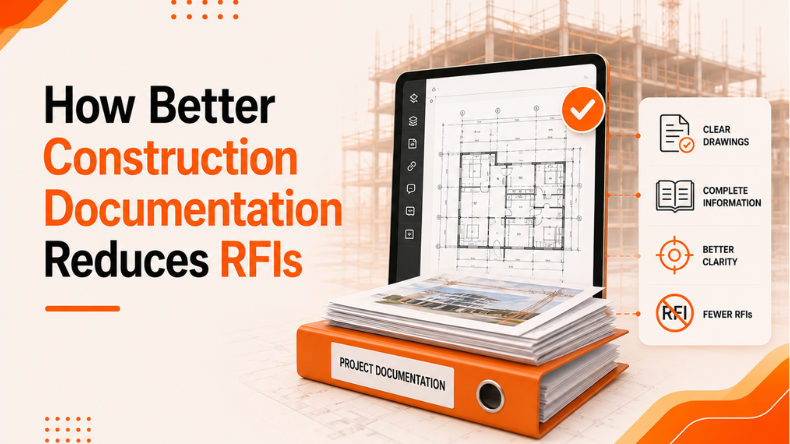
How Better Construction Documentation Reduces RFIs

Summarize this post:

Instantly extract the key takeaways from this article using AI.
Construction teams don’t have an information problem. They have a timing information problem. The superintendent needs to confirm a wall assembly, the plumber needs a pipe specification, and the electrician needs to determine the location of the panel. The answers may be buried in hundreds of drawings, specs, schedules, and revisions, and what started out as a simple inquiry quickly becomes an RFI or work stoppage and rework.
Every site question that goes unanswered creates friction in the process. Crews stop working, project managers are forced to interrupt their workflow by answering questions, and the designers are pulled out of their workflow. RFIs often create delays that impact productivity and schedules. Improving construction documentation can help fill the information gap. If the project documentation is organized and searchable, teams can verify if the answer to the question is correct. AI-based analysis of construction documents allows search in a much more user-friendly way by enabling the user to ask questions.
A goal is to understand how users interact with technologically advanced construction project documentation systems and how that interaction will impact the way builders work. This blog will help to identify the obstacles to advanced construction document interaction and inform building practices of precisely what is needed to inform and enable users to fully interact with Custom AI Workflows.
The entire building process creates a considerable mountain of paperwork, where every single trade brings their own thick manuals and heavy drawing sets. Plumbers have specific layouts for piping, while electricians follow strict codes for wiring, and structural engineers supply thick binders of load calculations. All this information rarely lives in one centralised place, which causes a daily challenge for the field workers who just want to get things done. Project data is fragmented because of storage in different places, hindering connectivity to real-world problems on the work floor.
Because of discrepancies in drawings, specifications, and field conditions, the teams may have to stop the work and ask for clarifications. Locating the disconnection is done through building information models in addition to traditional paper plans and through the review process. When information between mechanical, electrical, and structural disciplines is not well coordinated. These guesses lead to expensive rework that disrupts the careful schedule and hurts the planned budget for your company. The constant communication delay takes days when it should really only take a few minutes.
Manual searching really breaks down under standard project pressures because superintendents simply do not have the time to look through sheets hunting for tiny details. They search long specifications and cross-reference notes, trying to match calls while still wondering if they missed something crucial. Data lives across multiple sheets and different trades, with hundreds of specification pages containing hidden facts that take far too long to connect. Sometimes, quickly answering specific questions feels completely impossible because most busy building teams can only dream of verifying details without manual digging.
| Document Concept | Traditional Retrieval Method | Smart System Retrieval Method |
|---|---|---|
| Architectural Plans | Searching multiple sheets manually | Locate room dimensions quickly |
| Structural Drawings | Cross-referencing heavy paper binders | Find relevant load-capacity information |
| Mechanical Specifications | Reading long confusing text sections | Locate duct-clearance requirements |
| Fixture Schedules | Matching items across complex tables | Find fixture specifications and material information |
New artificial intelligence systems read notes and tags while understanding clauses to map connections automatically across the entire building project. Workers just ask a question in plain, simple words, and the system reads all sheets surface the most relevant information from the available project documents. The system is designed to ground answers in the uploaded project documents and provide source references for verification. Source references link directly to the correct spot so you can simply click the link and see the exact context without spending hours searching.
The system captures notes from every single drawing and maps connections automatically to supply answers without any fluff or confusing extra text.
The entire team stays perfectly aligned and moves fast because the field worker knows the exact fire-stopping requirement instantly. The plumber knows the pressure rating for pipes, and the electrician knows the exact panel location without calling the main office three times. Every discipline works from the exact same facts, which keeps the whole job moving forward smoothly and safely.
The shift from manual searching changes everything because workers can just ask a question to get an answer and then verify the source to return to work. Less effort with iFieldSmart AI leads to much better overall clarity, and decisions improve significantly because verified facts support every single choice made on the busy site. Before this new technology arrived, people flipped through endless sheets and looked through long, confusing specification sections trying to connect the dots manually. The old way was incredibly slow and very uncertain, but the new way is fast and highly accurate for everyone who needs answers.
Here are the simple steps your team can follow now.
What really slows teams down is access to information, and when answers are easy to find, daily decisions accelerate noticeably. Teams spend less time searching and more time building because the goal is to make existing data highly usable instead of adding new confusing data. Preconstruction teams verify design quality before starting work, and scope gaps become visible long before the specialised trades even arrive at the location. Automated logs track every single action item easily so the entire workflow shifts from reacting to problems to stopping them before they start.
Industry statistics highlight the high cost of delays when workers stand around waiting for an engineer to answer a simple formal question. According to an industry study by Navigant Construction Forum, an average formal question costs roughly one thousand dollars to review and answer. The study also shows that teams take an average of nine days to reply to a single formal request. Nine days is an absolute lifetime in building schedules, and this slow process completely stops progress on the active site while expenses pile up.
Another report by FMI Corporation shows that poor data causes billions of dollars in rework every single year globally. These reports prove that relying on old paper methods is completely unsustainable for any modern building firm. Labour costs rise rapidly when workers stand around waiting, and material costs increase heavily when schedules drag on longer than originally planned. Mistakes happen easily when teams build without proper answers, and rework ends up costing the industry substantial amounts of money annually. Every formal question represents a failure of communication, but better systems reduce these costly questions by finding answers directly to save money and time.
Projects stay under budget when questions disappear fast, and profit margins remain safe.
Consider a large commercial tower project located in Chicago where the busy team faced hundreds of formal questions every single month. Manual searching caused scheduling delays and intense frustration until they implemented a smart document system that changed everything almost overnight. The team uploaded all the mechanical and electrical plans into the system so workers could ask questions directly and find exact pipe sizes instantly. The software located fire-stopping requirements at duct penetrations perfectly, which caused formal questions to drop by forty per cent in just a few months. The project was finished faster and stayed under budget because everyone had immediate access to the exact facts they needed without any waiting.
Another case involved a large hospital building project in London where the plumbing and structural teams faced constant hidden conflicts in the tight ceiling spaces. The hospital ceiling contained miles of complex piping that nobody could fully understand using the old paper plans. The intelligent system detected clearances and spacing rules accurately while reading the detailed fixture schedule for every single level of the hospital. The coordination team resolved issues in active meetings instead of waiting days for formal answers, so the hospital opened on time and completely under budget. These true stories prove the value of instant answers because connected information solves real problems on the site and makes meetings highly productive. Furthermore, subcontractors bid with complete confidence and total clarity when they know they can find answers.
What types of files does the system support?
The platform reads specific plans and long specifications while handling schedules and supporting contract files very easily for the team. It processes text annotations and tiny drawing details accurately.
Does the digital tool verify accuracy?
Yes, every answer includes direct links to the original sheets so the user can open the source files to review the information visually. The original context remains completely intact, which provides complete confidence for the person reading the quick answer.
Does the software invent or guess missing critical information?
No, because the system only retrieves existing project data and never invents details if they are missing from the original uploaded files.
Which specific teams will benefit from this deep document intelligence?
Managers and field workers use it every single day to support estimating and active building phase operations safely. Architects and owners also use the system to verify details very quickly without bothering the busy engineering staff.
Can the smart system read mechanical and plumbing plan sets?
Yes, it reads duct sizes and exact airflow needs while understanding the fixture requirements and installation notes perfectly. It handles pressure ratings for complex piping systems easily so mechanical teams stay fully informed on the site.
What makes this system different from a general internet chatbot?
General systems use broad internet data for answers, but this platform focuses entirely on uploaded project files from the builder. It only retrieves grounded, verifiable answers connected to actual drawings instead of making things up from random outside websites.
Does the platform perform automated clash detection or model analysis?
No, because the system retrieves existing information from documents and does not generate predictive or automated coordination models. Its primary focus is retrieving verified project facts so teams can make smart choices on their own.
How do busy estimators use the system for accurate bidding?
Estimators locate exact material requirements and fixture counts quickly while reviewing specific wall types and hidden scope details. This helps them build highly accurate cost budgets without missing small details that often ruin the final profit margin.
The future of building large structures relies completely on connected data because asking a question and getting an instant verified answer is becoming the new standard. Manual searching belongs entirely in the distant past as smart systems organise complex files into highly useful answers for everyone involved. This amazing technology builds better and smarter structures globally while pushing the industry towards total clarity and complete daily confidence. Access to basic information will never slow your team down again because intelligent systems will read and connect every single tiny detail automatically.
Field teams will increasingly have project information available at the point of decision, helping reduce avoidable information gaps and coordination errors. Buildings will go up faster and much safer because the deep intelligence of the system will guide workers perfectly through complex tasks. Information will flow freely between the quiet office and the loud site, so the annoying gap between plans and reality will finally vanish. Every single project generates a considerable amount of data, but using that data properly separates successful modern builders from the rest. The ultimate goal is building safely and efficiently with tools like iFieldSmart AI while ensuring that modern technology firmly matches the complex scale of daily construction.
Explore more insights on similar topics
 RFI MANAGEMENT
Managing large design and construction projects poses significant challenges due to ongoing design updates, field...
 RFI MANAGEMENT
Thousands of details seen in construction drawings need to be consistent across several professions. Even...
 RFI MANAGEMENT
Construction teams ask questions every single day. One sheet says one thing. Another detail says...